
Centering Community in Climate Change Resilience, Water Governance and Policy Innovation: International Public Policy Association (ICPP7) - Chiang Mai, Thailand 2025
Written by Dr. Amanda Shankland

At the IPPA conference in Chiang Mai 2025, the panel, Centering Community in Climate Change Resilience, Water Governance and Policy Innovation, brought scholars from around the world together to examine how local communities can contribute more effectively to climate and water governance. The session, organized by Carolyn Johns and Debora VanNijnatten, emphasized participatory traditions in public policy, but asked us to consider how the urgent challenges of water and climate change demand innovative policy responses involving deeper community engagement.Presenters emphasized how water and climate policy cannot be designed or implemented without drawing on the lived experiences and knowledge of communities. This is particularly evident in relation to water, where challenges of quality, access, and security intersect with social and cultural dimensions of resilience.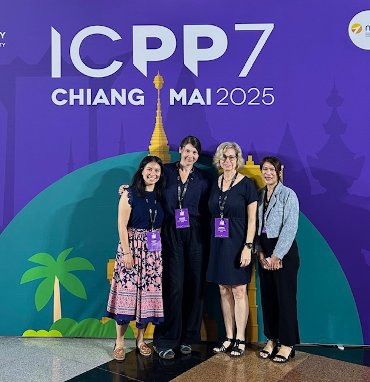
From left to right, Vianay Rueda, Amanda Shankland, Debora VanNijnatten, and Sudarat Rattanapong

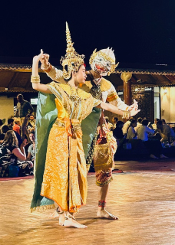
Pictures of the ceremonies taken by our GCTW team members
Several papers highlighted frameworks to better understand community-water relationships. The contribution from Debora VanNijnatten and Ryan Durante presented a Community-Water Relationship template, which outlines twelve variables to assess how communities depend on and use water resources as well as their vulnerability to climate impacts on those water resources. This analytical tool was applied to the Rio Grande-Bravo River Basin (U.S.–Mexico), revealing how communities can be more effectively linked to interstate governance structures. Another paper by Vianey Rueda, built on the idea of “hydrosolidarity,” proposing adaptive, equity-driven governance approaches for U.S.–Mexico border communities. Despite treaty-based institutional competition, the research shows strong cross-border convergence in residents’ water-use priorities, opening new pathways for binational cooperation and reform.The panel also explored the potential of community-based and participatory research approaches. A paper by Carolyn Johns and myself examined the transformative role of Community-Based Participatory Research (CBPR) in democratizing water governance, especially by amplifying the voices of Indigenous, Black, and newcomer communities, who are often excluded from decision-making. In a similar vein, work by Yingshan Lau reflected on the challenges of implementing participatory action research (PAR) in Laos, emphasizing the tensions between academic structures and community-centred methodologies. 
Throughout discussions, Indigenous knowledge emerged as a central theme. Research from Thailand and Japan by Sudarat Rattanapong highlighted how the Pakakayor and Matagi communities draw on centuries of ecological wisdom to manage watersheds and adapt to environmental change. Their practices, ranging from forest ordination ceremonies to bear spirit rituals, demonstrate how cultural traditions can reinforce both resilience and biodiversity conservation. Rituals embed conservation in spiritual obligations, and sacred beliefs limit the overuse of resources and inspire people to adopt preventative strategies. The work demonstrated the compelling reasons why policy frameworks must integrate Indigenous ecological knowledge into disaster preparedness and watershed governance, ensuring culturally sensitive and sustainable adaptation strategies.The panel underscored that community perspectives are indispensable to addressing the climate-water nexus. Rather than viewing communities as merely “vulnerable” or “marginalized,” the research showcased their role as innovators, agents, and partners in policy change. The session called for reimagining governance architectures that not only recognize but actively embed community knowledge and agency at local, national, and transboundary levels.